





















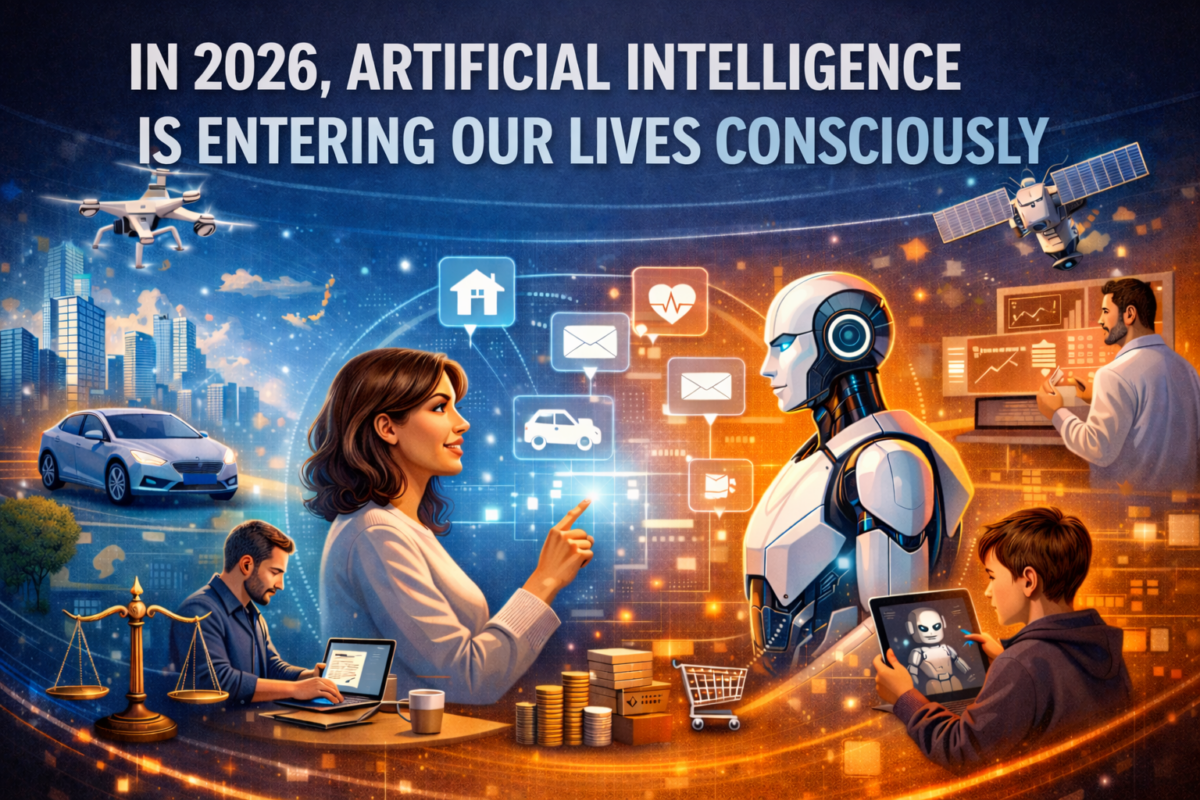
In 2026, AI Will Enter Our Lives Consciously, Not “Secretly”
The other day, a friend of mine said, “I don’t use artificial intelligence.” On the same day, he made a photo search on the phone, followed the traffic recommendation of the map, canceled his transaction with a fraud alert from the bank. Actually, the point is now “are you using?” it isn’t. The point is, do you realize you’re using it?
Over the last two years, artificial intelligence has transformed from being a feature that operates silently behind applications to taking center stage before our very eyes. What was once a small “smart” feature within an app is now evolving into a digital assistant that talks to us, understands context, and even completes minor tasks on our behalf. This is the most significant change as we move from 2024 to 2026: Artificial intelligence is transforming from a tool that provides answers into an assistant that gets things done.
This transformation has, on the one hand, accelerated with the steps taken by technology companies. Apple announced that it will place generative artificial intelligence at the core of its devices and stated that it aims for a system that “understands personal context.” Amazon outlined a vision for a more conversational and task-oriented Alexa. Google, on the other hand, has begun transforming the mobile assistant experience with new-generation models and has stated that this transition will take place over time. The common idea is that the assistant will not merely execute commands; it will understand what we mean and attempt to complete the process.
On the other hand, there is also the regulatory aspect to this issue. The European Union’s Artificial Intelligence Act has come into force and a risk-based framework has been adopted. In other words, not all artificial intelligence applications are the same; some areas are subject to more stringent regulations. The fact that the overall implementation process will extend to 2026 and that some elements will come into effect at a later date indicates that this transformation will progress gradually over time. In Turkey, too, the focus is on governing the artificial intelligence ecosystem through national strategy documents and action plans. In short, while technology is accelerating, regulation is also catching up.
We see this change most clearly in our homes. The first era of the smart home was the command era: “Turn on the light, play the music. ” Now, a more contextual understanding is developing. When you say, “Guests will be coming in the evening,” it’s not just about turning on the light; steps like shopping suggestions, meal ideas, and calendar checks are expected to be considered together. There’s a fine line here: Does the assistant offer suggestions, or does it take action with permission? In the coming years, we will hear the term “permitted automation” more frequently.
On the healthcare side, artificial intelligence often comes into play even before a hospital visit. Smartwatches can provide heart rhythm-related alerts, detect irregularities, and direct the user to a doctor. These systems do not replace doctors; but they do provide early awareness. This is where the real value lies. Nevertheless, the expectation of “one-button diagnosis” is both unrealistic and risky. When it comes to the use of large models in healthcare, issues of security, transparency, and governance become even more important.
There is a similar picture in education. Artificial intelligence-supported tools can assist teachers in preparation and provide personalized practice for students. However, ethical boundaries are also being discussed here. How much of the homework should the student do? Where is help acceptable? It seems that not only students but also teachers will need to acquire artificial intelligence literacy.
In business life, the impact of artificial intelligence is often felt more as a “time saver” than a “creative revolution.” Systems that generate meeting notes, summarize emails, and prepare action lists are becoming increasingly common. Following a meeting held on Monday, the answer to the question “Who was going to do what?” can now be provided in an automatic summary. However, the assumption that these summaries are error-free is not accurate; final verification must remain with humans.
Autonomous vehicles in transportation have become a real service in some cities. However, this does not mean that driverless vehicles exist everywhere and under all conditions. They operate within specific regions, within the framework of certain infrastructure and regulations. In other words, the technology exists, but full freedom is not yet achieved.
In the world of entertainment, artificial intelligence is one of the areas that has normalized the fastest. Music recommendations, personalized content feeds, and even interactive experiences with users are now becoming commonplace. The content is not chosen solely based on “what’s for you”; it is shaped by your feedback.
When we look at the entire picture, the benefits are clear: speed, personalization, accessibility, and efficiency. However, the risks are also real: misinformation, bias, privacy violations, and trust issues. Therefore, both regulations and ethical standards are strengthening. Artificial intelligence is no longer just a technical issue; it is also a legal and social matter.
You don’t need to be a technical expert to prepare for 2026. Thinking about artificial intelligence like an intern might be a good start: fast and helpful, but faulty at times. Especially in areas such as health, finance and law, a second verification should become a habit. Being more careful when sharing personal data, reviewing app permissions, and discussing the ethical dimensions of AI use with children are also important steps.
Ultimately, artificial intelligence won’t work miracles in 2026. But it will reduce minor time losses, simplify everyday tasks, and transform into an invisible assistant. What makes the difference will not be those who use the most advanced models; it will be those who ask the right questions, know when to say stop, and manage their data consciously. Because the issue is no longer whether to use artificial intelligence or not; it is how consciously we use it.